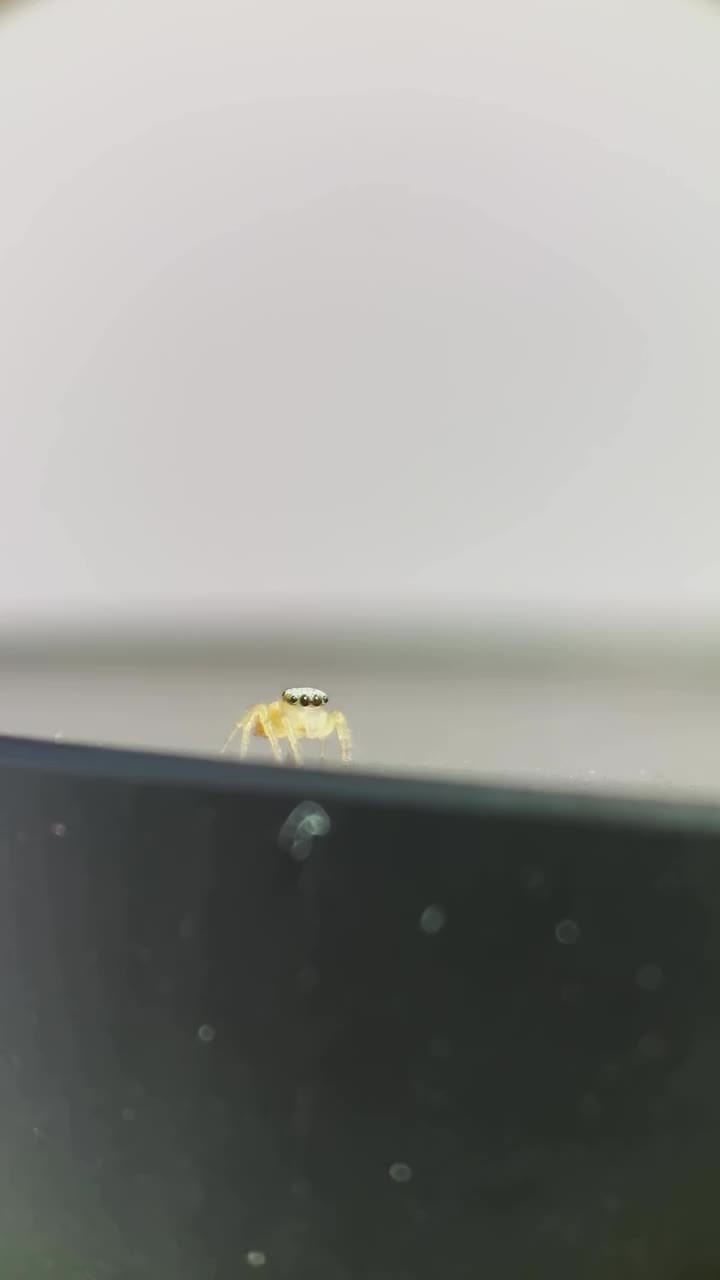
The first time I looked closely at footage of a young jumping spider, my instinct was the same as most people: cute, a little unsettling, surprisingly expressive. Then I started paying attention to what those eyes were actually doing, and the cute wore off fast, replaced by something closer to genuine awe. This is not a spider with eight eyes for redundancy. This is a spider running a sophisticated, multi-channel visual operation inside a body smaller than a pencil eraser.
Eight Eyes, But Not Eight of the Same Thing
The key thing to understand about a jumping spider's vision is that the eight eyes are not doing the same job. They are divided into two functionally distinct groups, and those groups do not overlap in purpose.
The two large eyes at the front, called the principal eyes or anterior median eyes, are the ones that give jumping spiders their famously expressive appearance. These are the eyes that look back at you. They are built like telephoto lenses: narrow field of view, exceptional resolution, capable of picking up fine detail at a distance that seems impossible for an animal this size. According to research published in the journal Science, jumping spiders in the genus Portia can spot prey from up to 30 centimeters away, a distance that represents many times their own body length. That kind of acuity in a spider-sized package requires a genuinely unusual optical structure.
The remaining six secondary eyes are arranged around the head to provide nearly 360-degree coverage. They are not built for detail. They are built for motion detection, scanning the peripheral field and flagging anything that moves. When something enters that wide field, the spider orients toward it so the principal eyes can assess it properly. The two systems hand off to each other in sequence.
A Visual System That Functions Like a Collaboration Between Two Instruments
What makes this architecture interesting is that neither eye system alone would be sufficient. Wide-angle motion detection without high-resolution follow-up would leave the spider aware of movement but unable to judge distance, size, or species accurately. High-resolution forward vision without peripheral coverage would make the spider effectively blind to anything approaching from the side.
The combination solves both problems. The secondary eyes act as the early-warning network. The principal eyes act as the targeting system. Together they give a jumping spider a functional visual range and resolution that researchers have found rivals that of animals with much larger brains and far more neural processing power.
There is also a physical detail that makes the principal eyes even more unusual: the retina inside each one can actually move, controlled by small muscles, allowing the spider to shift its gaze without moving its head. This is rare in arthropods, and it is one of the reasons jumping spiders appear so alert and watchful. They are watching. Actively and deliberately.
What a Young Spider Is Still Learning
The footage that first caught my attention features a juvenile spider, and that detail matters. Young jumping spiders are not born with fully calibrated visual behavior. The eight-eye system is present from early life, but the integration of signals from different eyes, and the coordination between visual input and predatory movement, appears to develop with experience.
This is a subtle but important distinction. The hardware is there. The software takes time. A juvenile spider encountering prey for the first time is running a sophisticated sensory system that it is still learning to use effectively. Watching one explore its surroundings, turning, pausing, tracking, is watching a predator in the process of becoming competent at being a predator.
Why This Matters Beyond the Cuteness
I find the jumping spider's visual system compelling for the same reason I find any piece of precision engineering compelling: it solves multiple hard constraints at once inside a volume budget that should make the whole thing impossible.
The principal eyes achieve resolution that requires an unusually long focal length relative to body size. Researchers have noted that the eye tubes in jumping spiders are longer in proportion to the animal than almost any comparable structure in the arthropod world. Getting that focal length inside a spider-sized head means the eye tubes extend almost to the back of the cephalothorax. The animal is, in a very real sense, mostly eye.
The secondary eyes, by contrast, are optimized for a completely different constraint: maximum coverage with minimal neural overhead. They do not need to produce detailed images. They need to detect motion reliably, and they do.
The result is a sensory system with capabilities that most animals two or three orders of magnitude larger do not have. That is not a coincidence. It is the product of a very long evolutionary process refining a specific solution to a specific problem: how to be a small visual predator in a world full of things that can eat you.
The next time someone watches a jumping spider turn and look directly at them, the reaction is usually that the spider seems almost aware in a way that other insects and arachnids do not. That feeling is not wrong. It is the correct response to a genuinely unusual visual intelligence, running in a package that weighs a fraction of a gram.