

I have spent 19 years in digital advertising and e-commerce, working in the UK, France, and Dubai for companies like Yahoo and others across the MENA region. In all that time, one problem kept getting worse: brands were spending millions on online ads, and consumers were tuning them out completely. By the time I co-founded Boostiny, the situation had reached a tipping point. 70% of internet users no longer trusted online ads. That number is not a complaint. It is a market signal. And I decided to build a business around it.
The Three Problems Advertisers Face Today
When I sat down to design Boostiny, I started with three structural problems I had been watching accumulate for nearly two decades.
First, in a market like Tunisia, brands spend millions of dinars in foreign currency just to run ads on Facebook or Instagram. That spend is not accessible to every business, and the platforms control both the pricing and the reach. You pay, and you hope.
Second, internet users are increasingly indifferent, or outright hostile, to online advertising. The banner blindness phenomenon is real. According to global survey data, personal recommendations from friends and family are the most trusted advertising channel among consumers, with nearly 90% of respondents trusting word-of-mouth recommendations above all other formats. Meanwhile, social media advertising sits near the bottom of the trust rankings. The platforms have monetized attention but destroyed credibility in the process.
Third, mega and micro influencers, despite their popularity, are limited in reach, expensive to manage, and difficult to scale. Their audience is narrow, their pricing is opaque, and the operational complexity of running campaigns across dozens of them is prohibitive for most SMEs. These three problems together created the exact market opening I needed.
The Collaborative Economy, Applied to Advertising
The insight that led to Boostiny was simple, but I had never seen it applied cleanly to advertising. When you need a car, you go directly to a private individual on Uber. When you need a place to stay, you go to Airbnb. You bypass the intermediary and pay the person who actually delivers the service. I asked: why not do the same thing for social media advertising?
Instead of paying Facebook or Instagram to broadcast your message, you pay their users directly. Not the mega-influencers with millions of followers, but ordinary people with small, engaged, and trusting communities. Every single one of us, when we share, like, or comment online, influences the people who follow us. We are all nano-influencers for our own small communities. And in the MENA region alone, that pool of potential boosters reaches 690 million people.
I called this model "crowd advertising." It is a new and more effective way to reach new customers, and a direct alternative to conventional social media advertising.
How Boostiny Works: The Product Mechanics
Boostiny is a self-service web platform for businesses that connects them, via our mobile application, to a network of thousands of social media users who become "boosters." Here is the exact flow.
An advertiser logs into the platform, creates a campaign with one or more offers, and sets the commission they are willing to pay per qualified lead or transaction. That is their entire commitment upfront: they define the result they want and the price they are willing to pay for it. No guesswork, no upfront media spend.
On the other side, Boostiny's predictive algorithm identifies which boosters in the network are the best match to promote that specific product. The algorithm accounts for each booster's audience profile, engagement history, and niche alignment. The offer is then shared through any social network or messaging platform the booster chooses. If someone clicks on the link and completes the desired action, the booster earns her first revenue. The transaction is tracked automatically, and the commission is distributed without manual intervention.
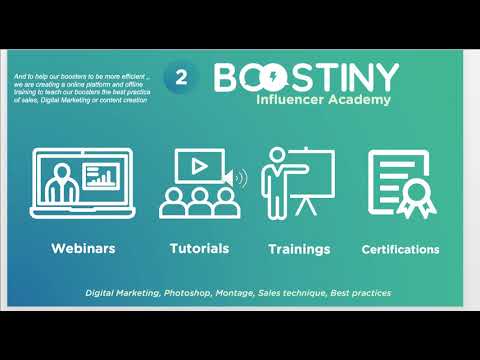
All of this is continuously optimized through a machine learning process that improves matching quality over time. We also built online training resources and offline coaching for boosters to teach them best practices in digital marketing, sales, and content creation. The goal is not just to connect supply and demand. It is to make every booster more effective, and therefore more valuable to advertisers.
Why Nano-Influencers Outperform the Alternatives
The instinct of most advertisers is still to chase big names. I understand the logic. A million followers feels impressive. But the data tells a different story. Across ROI metrics, nano-influencers consistently outperform macro-influencers. Return on influencer spend, which considers both revenue and costs, is more than three times higher for nano-influencers compared to macro-influencers. The reason is straightforward: when an influencer has 2,000 to 10,000 followers, their content feels peer-to-peer. The recommendation does not feel like an ad. It feels like a friend. That authenticity boosts trust and conversion.
Nano-influencers have a content engagement rate of 5%, which is significantly higher than the industry average of 2.2%. And unlike macro-influencers, who charge fixed fees regardless of results, our boosters are paid on pure performance. No click, no transaction, no commission. That alignment of incentives is the core structural advantage of the Boostiny model.
In 2024, 44% of brands now prefer working with nano-influencers, a shift that validates exactly what I was building at Boostiny years earlier. The market took time to catch up to the logic, but the direction was always clear.
The Business Model: Simple, Scalable, Aligned
I designed Boostiny's revenue model to be straightforward and tied directly to value creation.
The primary revenue streams are three. First, subscription packs for businesses who want continuous access to the booster network. Second, a revenue share on the commissions paid to boosters: we take a 30% share and management fees on every transaction that flows through the platform. Third, campaign management fees for advertisers who want us to handle the end-to-end execution of their campaigns rather than managing it themselves.
This structure means Boostiny only makes money when advertisers make money. There is no fee for reach that never converts. There is no upfront spend that disappears into a black box. The model is inherently performance-based, which creates the kind of trust with advertisers that conventional ad platforms have long since lost.
The platform also trains boosters at no cost to them, giving them a real income stream in exchange for their organic social influence. That creates retention on both sides of the marketplace.
A Market That Could Not Wait
The timing for Boostiny was deliberate. The MENA social media advertising market was growing fast, and I knew we had to move before the window closed.
The MENA advertising market value stood at US$8.11 billion in 2023 and is expected to reach US$17.36 billion by 2029, growing at a CAGR of 13.39%. Within that total, social media and digital are the driving segments. People in the region spend an average of 3.5 hours daily on social media, which means the raw material for a booster network, real people with real social media habits, is abundant and growing. The GCC region is increasingly moving towards performance-based advertising, showing a strategic shift towards more efficient and trackable advertising strategies.
My thesis from day one was that Tunisia would serve as a test market, and that the real prize was MENA-wide expansion. The economics of digital advertising in the region, high social media penetration, strong mobile adoption, and underdeveloped performance advertising infrastructure, made the opportunity timing-critical. We needed to build fast, prove the model, and expand before competition arrived.
Early Traction: Proof Without a Marketing Budget
One of the things I am most proud of from the early Boostiny days is how we built initial traction. We generated it without spending a single dinar on marketing.
By the time of our Flat6Labs Demo Day pitch, we had already embarked 15 beta advertisers, onboarded more than 300 boosters, and generated more than 700 leads and transactions. We were generating revenue, with close to 31 months of history and more than 8,000 active users on the platform. We had strong interest from both sides of the marketplace, advertisers and boosters, without any outbound marketing effort.
That organic pull matters. It signals genuine product-market fit, not manufactured demand. When people discover a product and join without being solicited, it tells you the underlying need is real and the solution is credible. For an investor evaluating an early-stage marketplace, zero-marketing traction is one of the strongest signals possible.
The Fundraising Ask and the Expansion Plan
At the Flat6Labs Demo Day, I was raising 800,000 Tunisian dinars. We had already secured 100,000 dollars from a prior round, and we were looking for 400,000 more to complete the product, consolidate the team, and launch rapid international expansion.
The capital allocation was specific: team and technology consolidation first, then user acquisition, then international market entry. Tunisia was always the sandbox. The commercial ambition was MENA-wide and beyond. In a three-year horizon, we were targeting 4 million dollars in revenue and coverage across the entire region.
The reasoning was direct: the market was growing fast, competition was nearly absent, and we had already demonstrated that the model worked. The only constraint on speed was capital. That is the only use case for a fundraise that actually makes sense.
The Founding Team: Experience That Matches the Ambition
I brought 19 years of hands-on experience in digital advertising and e-commerce to this venture. I had built and scaled products across the UK, France, and Dubai, and I understood both the advertiser psychology and the platform dynamics that Boostiny needed to navigate. My co-founder brought 5 years of deep web and mobile development experience, and we had a marketing team of rare talent supporting execution.
Founder-market fit is something investors often evaluate instinctively. In our case, the fit was exact: a team that had lived inside the problem we were solving, across multiple markets, for nearly two decades. That is not something you can accelerate with funding alone.
Boostiny was eventually acquired by ArabyAds, and the experience of building, proving, and exiting that product is what shaped my view on how performance marketing, nano-influencer networks, and AI-driven matching will define the next generation of digital advertising in MENA and beyond.
If you are building a digital product and want to think through your growth strategy, product roadmap, or AI integration with someone who has done it from zero to exit, reach out at nachnouchi.com.