

I built Boostiny because I observed a problem that the industry was refusing to admit. After 19 years working in digital advertising and e-commerce across the UAE, the UK, France, and Tunisia, including stints at Yahoo and in the programmatic space, I had watched the same pattern repeat itself: brands spent more on online ads, results got noisier, and trust kept eroding. At some point I had to stop watching and start building.
This is the full story of what I pitched at the Flat6Labs Tunis 3rd Demo Day, why I believed in it, and what the early numbers confirmed.
The Problem Is Not the Budget. It Is the Trust.
Let me start with the number that drove every decision I made on Boostiny: 70% of internet users do not trust online ads anymore. That is not a marginal figure. That is a majority of the audience brands are trying to reach, actively tuning out the very messages those brands are paying to deliver.
Declining trust in media trickles down directly to how advertisers connect with consumers, impacting ad effectiveness and accelerating media fragmentation. The consequence is straightforward: the more people scroll past banner ads and pre-roll videos, the more brands are forced to buy more impressions to compensate, and the more the signal-to-noise ratio collapses.
This is a structural crisis, not a tactical one. You cannot fix it by optimizing your creative. You cannot fix it by shifting from Facebook to TikTok. The problem is that people have learned to ignore anything that looks like a paid ad, regardless of where it appears. What they do not ignore is a recommendation from someone they know, or at least someone they follow because they genuinely trust what that person says.
According to a global consumer survey, personal recommendations from friends and family remained the most trusted advertising channel, with nearly 90% of respondents trusting word-of-mouth recommendations. That gap between trusted peer recommendation and distrusted paid ad is the exact gap Boostiny was built to bridge.
We Are All Nano-Influencers. That Is the Insight.
Here is the reframe that sits at the core of Boostiny. Every time you share a post, comment on a product, or like a brand's content online, you are influencing the people who follow you. Your community may be 200 people. It may be 2,000. It does not matter. That small, tight network trusts your opinion far more than it trusts a sponsored post from a company it has never heard of.
We are all nano-influencers. That is not a metaphor. It is a product thesis.
Research confirms that nano-influencers carry the highest overall engagement rate across influencer categories, reaching 6.23% on Instagram alone, and engagement consistently decreases as follower count increases. The intimacy of the small community is a feature, not a bug. The person with 800 followers who recommends a product is doing something qualitatively different from the celebrity with 8 million followers running a paid campaign: they are lending personal credibility, not renting their audience to the highest bidder.
According to a 2024 inBeat report, 44% of brands already preferred collaborating with nano-influencers, compared to only 17% for macro-influencers. The market was already moving in this direction. Boostiny gave that movement a platform, a payment mechanism, and a performance layer.
The Product: A Self-Service Platform Built on Commission Logic
Boostiny is a self-service web platform for brand advertisers, paired with a mobile app for the boosters who promote those brands. The mechanics are simple by design.
An advertiser, say a retailer wanting to promote a new product line, creates a campaign on the platform. They set the commission amount they are willing to pay for every qualified click or completed transaction. That single decision defines their entire risk profile: they only pay when performance is delivered. There is no upfront media buy, no impression-based fee, no paying for reach that may never convert.
On the other side of the platform, a booster, an ordinary social media user with a genuine community, receives a personalised link to that product. She can post it on Facebook, share it via WhatsApp, distribute it on Snapchat or Viber, or embed it anywhere her community gathers. If someone clicks the link, she earns her first revenue. If someone completes a purchase, the platform tracks the transaction, calculates her commission, credits her account, and allows her to cash out through mobile payments or bank transfer.
On the commission generated, Boostiny takes a 30% share and fees. If we manage the campaign directly, the fee structure reflects that additional service. The model aligns incentives perfectly: the advertiser pays only for results, the booster earns only by driving results, and Boostiny profits when both sides win.
The Algorithm That Makes the Matching Precise
The part of Boostiny that separates it from a simple affiliate link generator is the predictive matching layer. Not every booster is the right booster for every product. Sending a shoe campaign to a booster whose community is primarily interested in cooking is a waste of everyone's time and damages the booster's credibility with her own audience.
Boostiny's predictive algorithm detects which booster is the best fit for a specific product at a specific moment. It analyses the booster's audience profile, her posting history, engagement patterns, and community interests, then surfaces the right product-booster pairing. This is where the AdTech and machine learning dimension of the platform creates real value. The result is that advertisers get highly relevant distribution, and boosters only promote products they are actually positioned to sell.
Industry data shows that 60.2% of marketers are now using AI tools for influencer identification and campaign optimisation, and 66% of those using AI report improved campaign outcomes. Boostiny embedded that logic directly into the platform infrastructure from day one, rather than bolting it on later.
This also means the platform scales without requiring a manual curation team. The algorithm does the matchmaking. The advertiser and booster self-serve. Human intervention is reserved for complex campaigns that require active management.
The Market We Were Targeting and Why the Timing Was Right
The social media advertising market in MENA was the strategic frame for Boostiny's growth plan. When I built the pitch, the market was growing at more than 20% per year and was on track to reach $4 billion by 2020. According to Astute Analytica, internet ad expenditure in MENA was projected to rise by 20% by 2024, while newspaper ad spend was forecast to decline by 13%.
The MENA advertising market stood at $8.11 billion in 2023 and is expected to reach $17.36 billion by 2029, growing at a CAGR of 13.39%. The structural shift toward digital, and within digital toward social, was not speculative. It was already happening.
What made the timing particularly sharp was the nature of that spend. Major platforms like Facebook and Google were dominating a large portion of digital advertising spend in MENA, with paid social media advertising representing the biggest segment of digital advertising spending in the region. This meant that a significant share of marketing budgets were flowing out of local MENA economies and into the pockets of American tech giants, with no guarantee of local-market relevance or authentic community reach.
Boostiny was designed to capture a portion of that spend and redistribute it into local booster networks: real people, earning real commissions, inside their own communities. That is not just a product story. It is an economic argument for why a MENA-native platform had a structural advantage over imported advertising infrastructure.
Tunisia as the Controlled Test Market
We chose Tunisia as our first market deliberately. A controlled test environment before a MENA-wide rollout is not a compromise: it is the disciplined way to validate product-market fit, fix your funnel, and stress-test your operations before you face the capital requirements of scaling into Egypt, Morocco, Saudi Arabia, and the UAE simultaneously.
The Tunisia-first approach also gave us room to build strategic partnerships that would serve as distribution infrastructure. We partnered with Media Net, the largest digital agency in Tunisia, and with a successful mobile payment and micro-payment provider. These partnerships addressed two of the most practical friction points in the booster model: getting advertisers on the platform, and making sure boosters could actually receive and use their commissions. Distribution and payment were not afterthoughts. They were part of the first-year architecture.
Our target for year one in Tunisia was 20,000 boosters, 45 advertisers, and 400,000 dinars in revenue. Year two: Morocco and Egypt. Year three: the rest of the Middle East, scaling to 100,000 boosters, 200 advertisers, and 5 million dinars in revenue. Each phase had to be funded by the previous one, which is exactly why the fundraise was sized the way it was.
Traction Before the Raise: The Number That Mattered Most
When I stood on that stage at Flat6Labs, I had one proof point I wanted every investor in the room to hear clearly: we had achieved significant early traction with zero marketing spend.
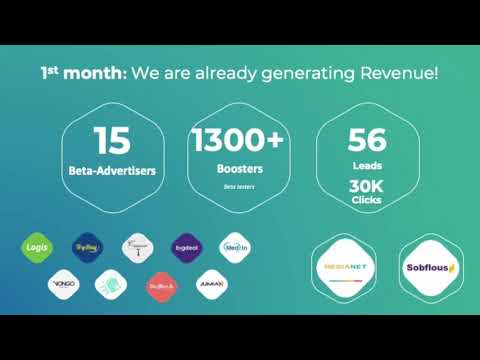
In three months of beta operation, Boostiny onboarded 15 advertisers, recruited more than 300 boosters, and generated more than 700 leads and transactions. We had demonstrated strong interest from both sides of the marketplace, boosters and advertisers, without spending a single dinar on acquisition.
This matters for one reason: it de-risks the core assumption. The standard objection to a two-sided marketplace is that you cannot get supply without demand, and you cannot get demand without supply. We showed that both sides were willing to engage before we had the marketing budget to push either. The product was generating pull on its own.
Industry data shows that 61% of brands report their primary influencer strategy now involves nano and micro-influencers, which confirms that the demand-side behaviour we observed in our beta was not idiosyncratic. The shift was structural, and our beta cohort was the leading edge of it.
The Raise and How We Planned to Deploy It
We raised 800,000 Tunisian dinars. The allocation was not vague. Three specific buckets: marketing to recruit boosters at scale, sales capacity to accelerate advertiser acquisition, and team growth to build the operational muscle to handle both.
Raising money with a specific deployment plan is not a formality. It signals to investors that you understand unit economics. If we knew that one dinar spent on booster recruitment translated to a predictable volume of transactions, we could model the return on that 800,000 with reasonable precision. That is the kind of discipline that separates a pitch from a wish.
Fundraising is not about telling a story. It is about showing that the story has numbers behind it, that those numbers connect to a coherent operational plan, and that the team in front of you has the track record to execute.
The Team Behind the Platform
I brought 19 years of experience in digital advertising and e-commerce to Boostiny. My background spans Yahoo in the UK and France, the UAE advertising ecosystem, and digital publishing in Tunisia. That experience was not decorative. It meant I understood both the advertiser's frustration and the platform mechanics needed to solve it.
Our CTO Mohammed brought more than five years of mobile and web development experience, which was directly relevant to the dual-surface architecture of Boostiny: a web platform for advertisers and a mobile app for boosters. Rim and Aziz handled marketing and outreach. A group of talented interns completed the team.
The founding team principle I hold to is complementarity. A CEO who understands the market, a CTO who can build the product, and operational leads who can execute the go-to-market. No redundancy in skills. No gaps in coverage.
What Boostiny Taught Me That I Carry Into Every Engagement
Boostiny was later acquired by ArabyAds, and from there I scaled ArabyAds from $70M to $100M+ ARR as CPO. But the lessons that shaped my thinking were formed in that Flat6Labs pitch room.
The first lesson: the best product ideas come from problems you have personally observed and verified, not from trend reports. I had spent two decades watching advertisers waste money on distrusted formats. Boostiny was the direct translation of that observation into a platform.
The second lesson: traction without spend is the most credible signal you can bring to an investor conversation. It means the pull is real. It means people found you because the product solves something they were already experiencing.
The third lesson: market size is context, not argument. Saying the MENA digital ad market was worth billions was not the pitch. The pitch was the mechanism: why boosters would join, why advertisers would pay, and why the algorithm would keep both sides engaged over time.
These are the principles I now apply when working with founders and SMEs on product strategy and growth architecture. If you are building a product and want to pressure-test your logic, your market framing, or your go-to-market before you stand in front of investors, visit nachnouchi.com and request a consultation.